

Introduction
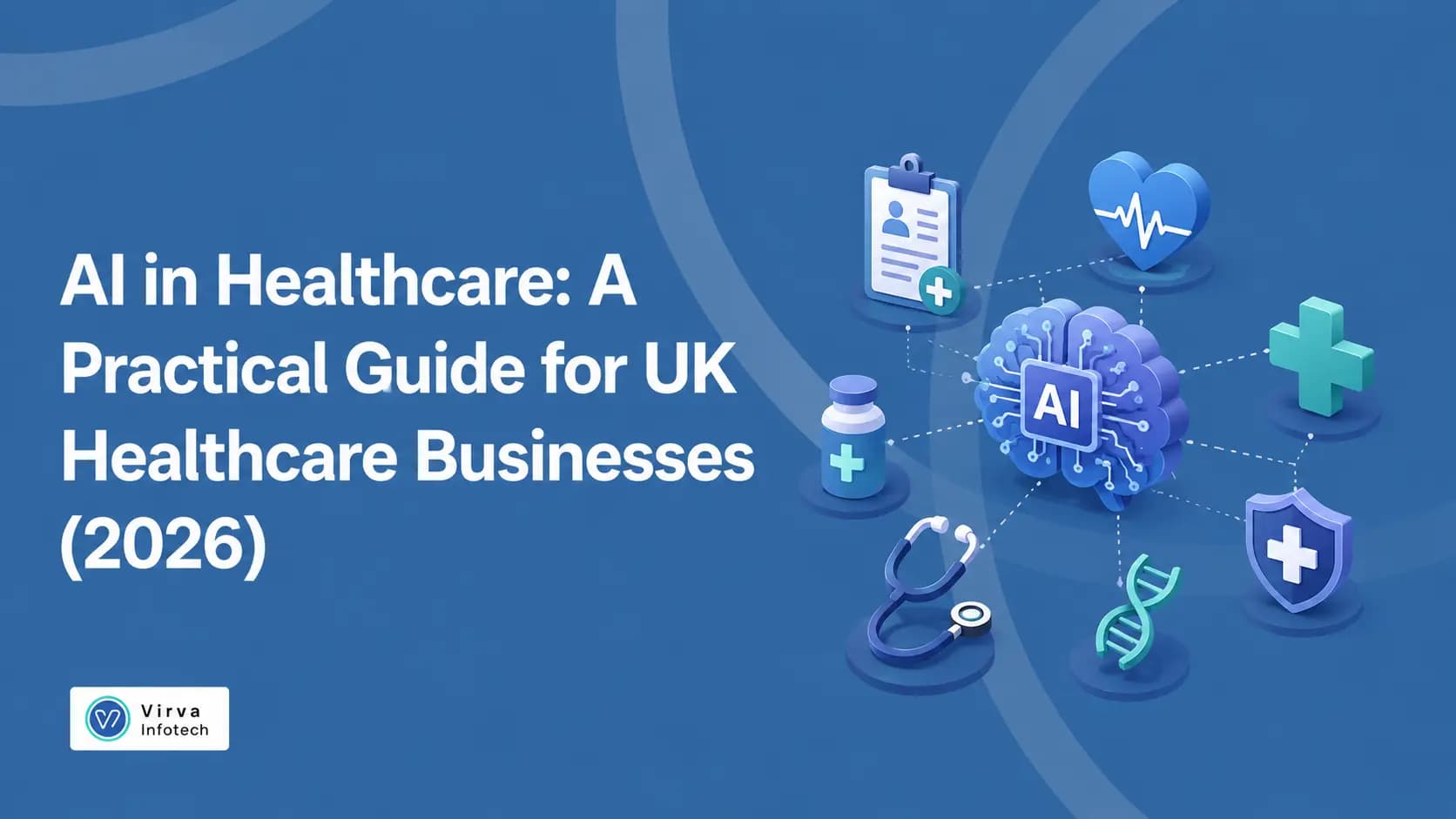
Healthcare is one of the industries with the clearest potential AI benefit — reducing administrative burden, speeding up triage, and helping staff focus on patient care instead of paperwork. It's also one of the industries where getting AI wrong carries the most serious consequences, which means the approach needs to be more careful, not less ambitious.
This guide covers realistic, genuinely useful AI use cases for UK healthcare businesses, the compliance and data protection considerations that matter most, and honest costs for 2026.
For the broader fundamentals, see our AI development guide for UK businesses.
Where AI Genuinely Helps in Healthcare — And Where It Shouldn't Replace Clinical Judgement
The clearest, safest wins for AI in healthcare are almost all on the administrative and operational side, not the clinical decision-making side. That distinction matters enormously: AI that reduces the time a clinician spends on notes, scheduling, or paperwork is a low-risk, high-value investment. AI positioned to make or heavily influence clinical decisions is a fundamentally different category, requiring far more rigorous validation, regulatory consideration, and human oversight — and for most healthcare businesses outside specialist medical device development, this isn't the right starting point.
Real AI Use Cases in UK Healthcare Businesses
Administrative automation: Automating appointment scheduling, reminder communications, form processing, and routine correspondence — freeing clinical and admin staff from repetitive tasks that don't require clinical judgement.
Patient intake and triage support: AI chatbots that gather initial patient information, symptoms, and history before a consultation, helping staff prioritise urgency and prepare more efficiently — supporting the triage process rather than making clinical decisions themselves. See our AI chatbots guide for the underlying cost structure that applies here too.
Clinical documentation support: AI tools that help summarise consultation notes or transcribe and structure clinical documentation, reducing the significant administrative time clinicians spend on notes — always with the clinician reviewing and confirming the final record.
Patient communication and FAQ handling: Answering common patient questions about appointments, services, opening hours, and general (non-clinical) information, reducing call volume on front-desk staff.
Operational forecasting: Predicting patient volume, appointment demand, or resource needs based on historical patterns, helping with staffing and capacity planning.
Document and records processing: Automating the extraction and organisation of information from referral letters, forms, and other paperwork into structured records.
Compliance and Data Protection Considerations
Healthcare AI carries specific considerations beyond standard GDPR compliance:
- Special category data — health data is classified as "special category data" under UK GDPR, requiring a higher standard of protection and a valid specific legal basis for processing, beyond what applies to general personal data.
- NHS and clinical system considerations — if your AI tool interacts with NHS systems or clinical workflows, additional standards and assurance processes may apply depending on the specific context and use case; this is worth clarifying early with the relevant bodies for your specific situation, as requirements vary.
- Medical device regulation — AI tools that are intended to diagnose, monitor, or directly inform clinical treatment decisions may fall under medical device regulations (MHRA in the UK), which involves a substantially more rigorous compliance and validation process than administrative AI tools. This is a critical distinction to get right early, as it fundamentally changes the scope and cost of a project.
- Data residency and security — health data processing typically requires clear data residency (UK/EU) and robust security measures, particularly when using third-party AI providers.
- Human oversight for anything patient-facing — even administrative or triage-support AI tools should have clear escalation to human staff, and should never be positioned as providing clinical advice or diagnosis unless developed and validated to the appropriate medical device standard.
Our strong recommendation: for any AI use case that touches clinical decision-making, diagnosis, or treatment, get specific regulatory guidance for your exact use case before development begins — this is a specialist compliance area, and the distinction between "administrative support tool" and "medical device" has real regulatory consequences. Our AI and GDPR guide covers the data protection fundamentals that apply across all healthcare AI use cases.
AI Development Cost for Healthcare Businesses (UK, 2026)
| Use Case | Complexity Factors | UK Cost Range | Timeline |
| Patient FAQ / administrative chatbot | Standard AI chatbot, non-clinical scope, healthcare data handling review | £5,000 – £8,000 | 6–10 weeks |
| Appointment/scheduling automation | Integration with existing booking systems, reminder workflows | £10,000 – £12,000 | 8–12 weeks |
| Patient intake/triage support tool | Structured data capture, integration with clinical workflow, careful scope definition | £15,000 – £20,000 | 3–6 months |
| Clinical documentation support tool | Transcription/summarisation, clinician review workflow, data security requirements | £20,000 – £30,000+ | 4–7 months |
Costs for anything approaching medical device classification will typically be substantially higher due to the validation and regulatory approval process involved — this should be scoped and budgeted separately with specialist input, not estimated using standard software development benchmarks.
How to Get Started Safely in Healthcare AI
- Start with purely administrative use cases — scheduling, patient communication, and documentation support carry far less regulatory complexity than anything touching clinical decisions.
- Get clarity early on whether your use case could be classed as a medical device — this single question fundamentally changes the project's scope, cost, and regulatory pathway.
- Involve your data protection officer or compliance advisor from the start, particularly given the special category status of health data.
- Keep a human clearly in the loop for any patient-facing AI interaction, with easy escalation and no ambiguity about what the AI tool is and isn't providing.
Considering AI for Your Healthcare Business?
Getting the regulatory scope right from the start — particularly the distinction between administrative support and anything approaching a medical device — is the single most important decision in a healthcare AI project. Our AI development team works through this with you before development begins.
Get in touch to talk through your use case, or read our full AI development guide for the broader fundamentals.