


Introduction
Launching a new digital product in the UK is exciting — but it can also be expensive and risky if you build too much too soon. Whether you're a London-based startup founder, a Manchester SaaS entrepreneur, or an established enterprise in Birmingham looking to test a new idea, developing a Minimum Viable Product (MVP) using custom software development services is the smartest way to validate your concept before committing to a full-scale investment.
In this comprehensive guide, we’ll explain how to build an MVP for the UK tech market, step by step — with practical insights tailored specifically to British and wider EU business standards, compliance expectations, and customer behaviour.
What is a Minimum Viable Product ?
A Minimum Viable Product (MVP) is the most focused and strategically reduced version of a digital product built with modern web and mobile development solutions
that still delivers clear value to its intended users. Instead of building a fully featured platform with every possible function, an MVP concentrates only on the core features required to solve a specific problem. The goal is not to launch something incomplete, but to release a lean, purposeful version that proves whether the idea works in real market conditions. For startups and established businesses across the UK and wider EU region, this approach reduces uncertainty and ensures that development decisions are guided by evidence rather than assumptions.
An MVP's primary role is to test product-market fit. Before investing significant time and money in full-scale development, businesses must establish that actual users are interested in the solution and willing to participate or pay for it. Companies can collect quantitative data on user behaviour, engagement levels, feedback patterns and conversion rates by launching an MVP. This is important. Real-world validation helps to reduce development risk, avoid unnecessary features, and prevent costly mistakes. The solution allows businesses to focus on real-world examples and user feedback, rather than relying solely on complex functionality that users may not appreciate.
In the competitive UK tech ecosystem — where user expectations around usability, security, and performance are particularly high — releasing a fully developed product without validation can lead to wasted budget, delayed market entry, and reputational risk. An MVP enables organisations to move quickly while remaining strategic. It allows teams to learn from early adopters, iterate efficiently, and strengthen the product step by step. Additionally, a validated MVP can help secure investor confidence or stakeholder approval by demonstrating tangible traction and proof of concept. Ultimately, an MVP is not about building less; it is about building smarter, faster, and with greater clarity.
Why MVP Development is Crucial in the UK Tech Market
The United Kingdom remains one of Europe’s most advanced and competitive digital economies, consistently attracting innovation, venture capital, and global talent. Major technology hubs such as London, Manchester, Birmingham, and Edinburgh continue to drive growth across fintech, health tech, SaaS, logistics platforms, artificial intelligence, and enterprise software solutions. In such a mature and fast-moving ecosystem, competition is intense, and customer expectations are significantly higher than in emerging markets. Businesses entering the UK technology space cannot afford to rely on assumptions or unvalidated product ideas. A well-planned Minimum Viable Product (MVP) allows companies to test demand efficiently while aligning with the specific standards of the British and wider EU market.
One of the most critical factors in the UK tech market is data protection and regulatory compliance. Users expect transparent handling of personal data, secure authentication systems, and clear consent mechanisms aligned with GDPR and UK data protection laws. Any digital product that fails to demonstrate compliance risks losing user trust immediately. Beyond legal obligations, British consumers prioritise credibility. A secure, privacy-focused MVP builds early confidence and strengthens brand positioning. For startups and SMEs, demonstrating compliance from the beginning can also improve investor perception and partnership opportunities.
Unlike markets where rapid experimentation without formal structure may be common, the UK digital landscape rewards businesses that combine innovation with reliability. MVP development in this region must balance speed with strategic planning, regulatory awareness, and user trust. By adopting a structured MVP approach, businesses can validate product–market fit while meeting the high standards expected within the UK and broader European technology ecosystem.
Step-by-Step Process to Build an MVP for the UK Market
1. Clearly Define the Problem You’re Solving
Every successful MVP begins with absolute clarity around the problem it aims to solve. Before writing a single line of code, you must identify the exact pain point your product addresses. Is it improving operational efficiency for SMEs in London? Is it simplifying digital payments for regional retailers? Or is it streamlining logistics management across the UK supply chain? A vague idea leads to a vague product — and vague products rarely succeed in the competitive British tech ecosystem.
Equally important is defining your target audience. The UK market is diverse, with varying needs across industries, age groups, and regions. A B2B SaaS platform targeting enterprises in London will have different expectations compared to a consumer app designed for users in Manchester or Birmingham. Understanding your exact user persona ensures your MVP focuses on solving a real, urgent problem — one that customers are genuinely willing to pay for.
In the UK, customer research should include structured market surveys, competitor benchmarking, analysis of industry regulations, and study of UK buyer behaviour patterns. British consumers tend to prioritise transparency, usability, and trust. Avoid building features based on internal assumptions or stakeholder opinions alone. Data-driven validation at this stage significantly reduces financial risk and prevents unnecessary feature expansion later in the development cycle.
2. Conduct UK-Focused Market Research
Beyond surface-level competitor checks, market research for an MVP in the UK must also take into account other factors. A comprehensive evaluation of competitors in the UK and the broader EU region is essential. It must also be reviewed for pricing models and subscription structures as well as feature positioning, user interface quality and customer feedback. Identifying existing features in the market allows you to identify genuine gaps rather than copying competitors' offerings.
Compliance research is particularly critical in the UK. For example, fintech MVPs must consider regulations set by the Financial Conduct Authority, while health-tech platforms may need to align with integration standards connected to the NHS where relevant. Ignoring these frameworks at the MVP stage can result in significant redevelopment costs later.
Thorough regulatory and competitive analysis ensures your product enters the market strategically positioned — not only differentiated in value, but also legally and operationally prepared. Early understanding of the regulatory environment reduces the likelihood of costly rework, compliance delays, or reputational risk after launch.
3. Define Your Core Features Using the MoSCoW Method
One of the biggest mistakes businesses make when building an MVP is including too many features. The MoSCoW prioritisation method — Must-have, Should-have, Could-have, and Won’t-have (for now) — provides a structured way to define scope clearly. For the UK market, this structured approach is especially valuable, as stakeholders and investors typically expect disciplined planning and measurable objectives.
Your MVP should only contain the necessary elements that are essential for proving your core value proposition. Delivering a functional user experience, providing comprehensible conversion and payment methods, and facilitating the collection of valuable feedback from users. Once validation is finished, it is recommended to add additional features that are desirable in subsequent stages of development.
It is important to understand that an MVP is not an incomplete or low-quality product. It is a focused, strategically reduced product built to test assumptions. By limiting scope at the beginning, you protect your budget, shorten development timelines, and gather clearer data on what truly matters to UK users.
4. Design a Clean, UK-Standard User Experience
The UK digital community places great importance on user experience. Easy-to-use, minimalistic design, fast performance, and accessibility are all qualities that British users seek. Despite the limitations of its features, an MVP must still feel professional and reliable. Bad design can have a detrimental impact on credibility, particularly in B2B settings.
Accessibility standards, including WCAG guidelines, should be considered from the outset. Mobile responsiveness is equally critical, as UK consumers increasingly rely on smartphones for business and personal use. Straightforward onboarding, clear instructions, and minimal friction during registration significantly improve early adoption rates.
Additionally, design considerations must include GDPR-compliant cookie consent mechanisms, transparent privacy policies, and clearly defined calls to action. Content tone should reflect British English conventions, maintaining cultural alignment with your audience. A well-designed interface builds trust, which is essential for user retention and long-term growth within the UK market.
5. Choose the Right Technology Stack
Technology choices taken in MVP development have long-term impacts. In the UK tech environment, businesses prefer secure, scalable and integration-ready solutions. The availability of reliable, compliance-supporting, and scalable options in cloud infrastructure platforms like Amazon Web Services, Microsoft Azure, or Google Cloud is a significant advantage for many organisations.
Your backend framework should prioritise security and modular architecture. An API-ready system allows future integration with UK payment gateways, CRM systems, accounting platforms, or enterprise software. Building with scalability in mind ensures your MVP can evolve smoothly into a full product without requiring complete redevelopment.
Security should never be compromised. Secure user authentication, encrypted data storage, and protection against common vulnerabilities are essential. Avoid technical shortcuts that may reduce short-term costs but create long-term scaling or compliance challenges. A well-structured technology foundation protects your investment and supports sustainable growth.
6. Develop Using Agile Methodology
Agile development is widely adopted within the UK technology sector because it enables flexibility, transparency, and faster iteration. Rather than waiting months to launch a finished product, Agile breaks development into short cycles known as sprints. Each sprint delivers measurable progress, allowing teams to test and refine continuously.
For UK startups seeking investor funding or stakeholder confidence, Agile provides clear benefits. It demonstrates a structured roadmap, milestone tracking, and measurable traction. Investors are more likely to support businesses that show controlled development processes and data-backed decision-making.
Continuous testing within Agile reduces technical errors and ensures each release maintains quality standards. Frequent feedback loops allow you to adapt to market insights quickly, ensuring your MVP remains aligned with user needs and regulatory expectations.
7. Ensure GDPR and UK Data Protection Compliance
Compliance is not optional in the UK and EU digital market. Your MVP must align with GDPR and UK data protection regulations from day one. This includes secure data storage, clear consent mechanisms, transparent privacy documentation, and systems that allow users to access or delete their data when requested.
Failing to comply can result in financial penalties and reputational damage — both of which are particularly harmful for startups trying to establish trust. Early legal consultation ensures your MVP architecture supports regulatory requirements rather than conflicting with them.
8. Launch to a Targeted UK Audience First
Rather than launching nationwide immediately, begin with a focused release. Targeted beta testing groups, regional user segments, or industry-specific early adopters provide valuable insights without exposing the product to large-scale scrutiny too early.
For example, you may initially launch within a specific industry cluster in Edinburgh or focus on a B2B niche audience in London. Controlled releases allow you to refine usability, pricing structures, onboarding processes, and technical performance before broader expansion.
Gather information through surveys, usage analytics, and structured interviews. Your product is now more polished, validated, and ready for market when rolled out across the UK or EU through this data-driven refinement stage.
9. Measure the Right MVP Metrics
The performance metrics you use to evaluate your MVP's success are crucial. To ensure user engagement, UK tech startups must keep track of Customer Acquisition Cost (CAC), Lifetime Value (LTV), conversion rates, and retention rates. The indicators indicate whether the product provides sustainable value or if it requires strategic modifications.
If early metrics show low retention or weak engagement, it may indicate that the core value proposition needs refinement. Pivoting early is far less expensive than scaling an underperforming product. Conversely, strong traction signals readiness for expanded feature development and marketing investment.
Clear, measurable performance tracking transforms your MVP from a simple test version into a strategic growth tool. It enables informed decision-making, reduces risk, and prepares your business for confident expansion within the competitive UK technology landscape.
Common Mistakes to Avoid in UK MVP Development
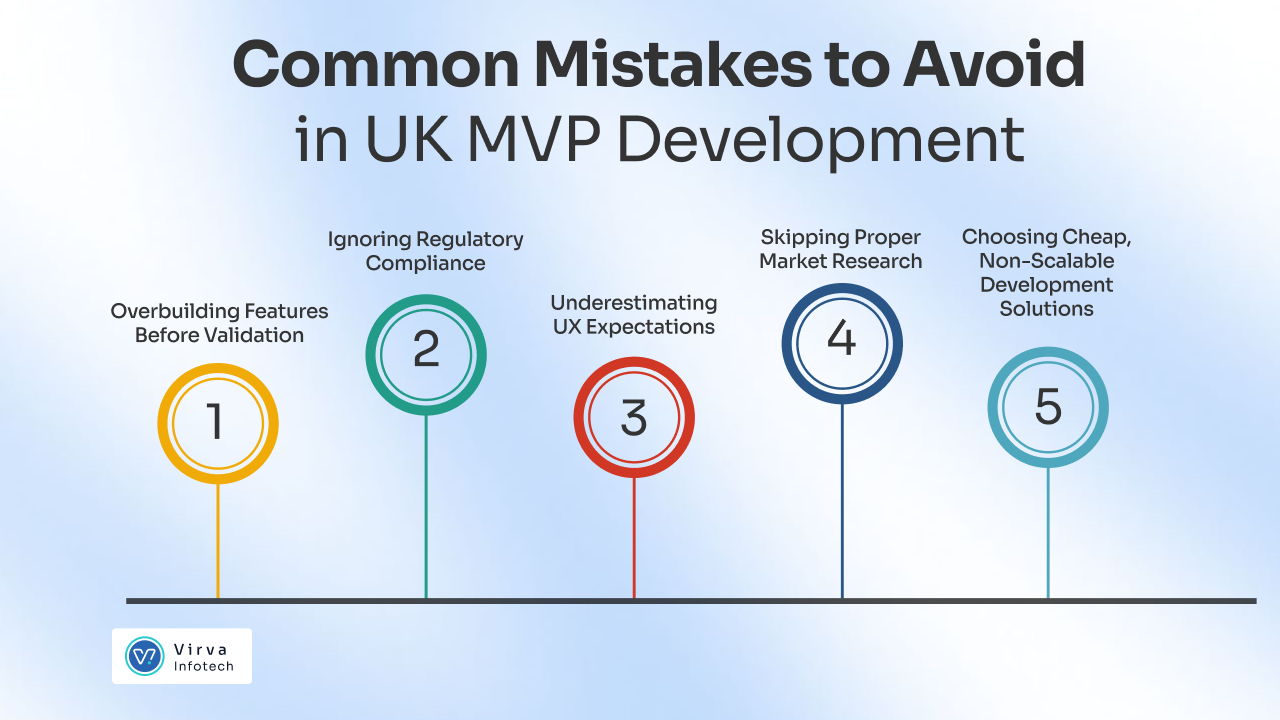
1. Overbuilding Features Before Validation
- Many startups attempt to launch with a “complete” product instead of a focused MVP, which increases costs and delays market entry.
- Adding too many features before validating real user demand often leads to wasted development budget and unnecessary complexity.
- In the competitive UK tech market, speed to validation is more important than feature quantity.
- Investors and stakeholders in the UK typically prefer evidence of product–market fit over extensive but untested functionality.
- A lean, strategically scoped MVP allows you to test your core value proposition before scaling further.
2. Ignoring Regulatory Compliance
- Failure to consider UK GDPR and data protection regulations at the MVP level can have severe consequences for both financial and reputation.
- Startups in fintech, for example, must align with guidance from the Financial Conduct Authority, while health-related platforms may require compliance considerations linked to the NHS.
- Lack of proper consent mechanisms, weak data security, or unclear privacy policies can erode user trust instantly.
- Retrofitting compliance after development is significantly more expensive than embedding it from the start.
- In the UK and EU market, compliance is not optional — it is a baseline expectation.
3. Underestimating UX Expectations
- In the UK, MVPs demand user-friendly interfaces, expert design, and optimal mobile responsiveness.
- Poor interface design or slow loading times have the potential to harm credibility and hinder early adoption.
- Accessibility standards (such as WCAG compliance) are increasingly important in both public and private sectors.
- Clear, cluttered or confusing onboarding can increase drop-off rates and damage conversion performance.
- Even with limited features, the product must feel polished, reliable, and trustworthy.
4. Skipping Proper Market Research
- Launching without in-depth competitor analysis can result in duplicating existing solutions with no clear differentiation.
- Without understanding UK buyer behaviour, pricing expectations, and industry-specific regulations, your MVP may not be able to connect with its target audience.
- Market surveys, customer interviews, and sector research help validate assumptions before development investment begins.
- Early validation should be ignored, which increases the likelihood of late pivoting - making it expensive and time-consuming.
- Data-driven decision-making significantly improves success rates in the UK tech ecosystem.
5. Choosing Cheap, Non-Scalable Development Solutions
- Selecting the lowest-cost development option often leads to poor architecture, technical debt, and future scalability problems.
- Non-modular systems make it difficult to add features, integrate third-party tools, or expand infrastructure later.
- Insufficient security systems in the UK can result in compliance flaws within data protection regulations.
- Rebuilding a poorly structured MVP can cost more than building it correctly the first time.
- A scalable, secure, and well-planned technical foundation supports long-term growth across the UK and EU markets.
How Long Does MVP Development Take in the UK? (Timeline and Cost Explained)
When planning a Minimum Viable Product for the UK market, two of the most important considerations are development timeline and budget investment. In the British technology ecosystem — where compliance, performance standards, and UX quality are high — both time and cost depend heavily on complexity, regulatory requirements, and scalability planning.
MVP Development Timeline in the UK
In general, MVP development in the UK follows these estimated timeframes:
- Simple MVP: 8–12 weeks
- Medium complexity MVP: 12–16 weeks
- Advanced MVP (AI, fintech, SaaS platforms): 16–24 weeks
However, these are not fixed timelines. The actual duration depends on several critical factors:
1. Feature Complexity
A product with basic login functionality, dashboard access, and simple workflows will naturally require less time than a system with advanced automation, AI-driven logic, or multi-role user management. The more customised the feature set, the longer the design, development, and testing cycles.
2. Compliance Requirements
Development time for digital products in the UK is significantly impacted by compliance. Regulations from the Financial Conduct Authority must be considered by fintech platforms, while health-tech websites may need to consider integration factors related to the NHS. Why is this so? Secure data handling, consent systems, and encryption protocols require additional structured development stages, but they safeguard long-term viability.
3. Integration Needs
When integrating with payment gateways, CRM systems, accounting software, banking APIs or enterprise tools (if possible), additional time is needed to configure and test the API securely. The duration of integration-related projects usually surpasses the 12-week limit.
4. Testing & Quality Assurance Cycles
UK users expect stable, fast, and reliable digital platforms — even at MVP stage. Structured QA testing, security audits, performance optimisation, and user acceptance testing ensure the product meets professional standards. Cutting corners during testing may reduce short-term timelines but can increase long-term costs.
In summary, while 8–12 weeks may be realistic for a straightforward MVP, products operating in regulated sectors or with advanced functionality should plan for a longer and more structured timeline.
MVP Development Cost in the UK (Indicative Range)
MVP development costs in the UK reflect both technical quality and regulatory expectations. Based on current industry standards:
- Basic MVP: £15,000 – £30,000
- SaaS or platform-based MVP: £30,000 – £60,000+
- AI-driven, fintech, or compliance-heavy MVP: Higher, depending on integrations and security architecture
1. Technical Architecture
To ensure a well-structured, flexible backend requires skilled developers and effective infrastructure planning. Including secure database configuration, cloud hosting, and API-ready architecture in the initial investment is advantageous now but detrimental to future redevelopment expenses.
2. UX/UI Design Standards
Professional UX tailored for UK users involves accessibility compliance (including WCAG standards), mobile responsiveness, clean design systems, and structured user journeys. High-quality design improves conversion rates and reduces user drop-off — making it a strategic investment rather than a cosmetic expense.
3. Security & Compliance
Data encryption, GDPR-aligned consent systems, secure authentication layers, and documentation processes increase development scope. However, failing to invest in compliance early can result in fines, reputational damage, and costly technical restructuring.
4. Scalability Planning
An MVP should be built as a foundation for growth — not a temporary prototype to discard. Choosing scalable technologies and modular architecture ensures the product can expand across the UK and wider EU markets without major redevelopment.
Scaling from MVP to Full Product in the UK Market
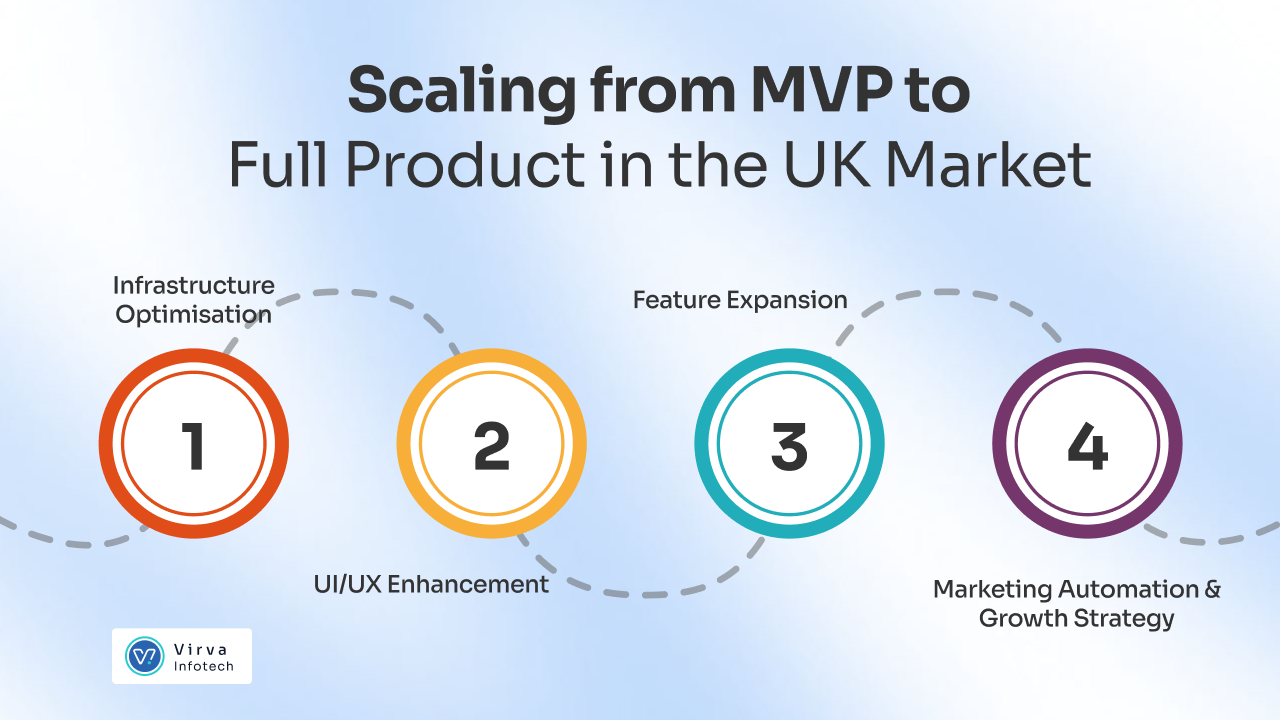
Once your Minimum Viable Product has been validated with real UK users, the next stage is structured and strategic scaling. Validation confirms that there is demand, but scaling transforms your solution into a fully competitive, revenue-generating digital product. In the UK technology ecosystem — where performance, compliance, and reliability are expected standards — scaling must be handled carefully to protect user trust and long-term growth potential.
Below are the key areas involved in scaling an MVP into a full product for the UK and wider EU market.
1. Infrastructure Optimisation
As user numbers grow, your technical infrastructure must evolve to support increased traffic, data storage, and performance demands. During the MVP phase, infrastructure is often configured for controlled testing. However, scaling requires:
- Load balancing for higher traffic volumes
- Cloud auto-scaling capabilities
- Database optimisation
- Enhanced cybersecurity monitoring
- Backup and disaster recovery planning
For UK-based digital platforms — particularly those operating in competitive regions like London and Manchester — downtime or slow performance can damage credibility quickly. Infrastructure optimisation ensures consistent speed, reliability, and secure user experiences.
Scalable cloud environments and structured DevOps practices help maintain operational stability as your customer base expands across the UK and potentially into the wider EU region.
2. UI/UX Enhancement
An MVP is intentionally minimal. Once validated, you can refine and elevate the user experience based on real behavioural data collected during early usage.
Scaling UX typically includes:
- Improved navigation flows
- Enhanced dashboard functionality
- Advanced accessibility compliance (WCAG alignment)
- Personalisation features
- Improved mobile optimisation
UK users expect clean, intuitive, and accessible digital experiences. Refining design elements such as onboarding processes, account management features, and content clarity strengthens engagement and retention. For B2B platforms in particular, a polished interface increases perceived professionalism and enterprise trust.
At this stage, usability testing becomes even more important to ensure improvements genuinely enhance performance rather than introduce complexity.
3. Feature Expansion
After validating your core value proposition, you can expand your product roadmap strategically. Feature expansion should be guided by:
- User feedback data
- Engagement analytics
- Revenue insights
- Competitive positioning within the UK market
Instead of adding features randomly, scaling should focus on high-impact functionality that strengthens product-market fit. This may include:
- Advanced analytics dashboards
- Automation tools
- Multi-user account management
- API integrations with UK-based payment gateways or enterprise tools
- AI-driven enhancements
The use of organized feature growth keeps your product relevant in the UK tech ecosystem and helps you stand out from competitors.
4. Marketing Automation & Growth Strategy
During the MVP stage, marketing is typically manual and targeted. Once scaling begins, structured marketing automation becomes essential to drive sustainable growth.
- Scaling marketing includes:
- CRM integration
- Email automation workflows
- Lead nurturing campaigns
- Retargeting strategies
- Performance tracking dashboards
For UK businesses, messaging must maintain professional tone, transparent pricing communication, and GDPR-compliant marketing consent processes. Automated systems should always align with UK data protection standards to maintain user trust.
A strong growth strategy ensures your product moves beyond early adopters and reaches a wider audience across the UK and EU markets without losing consistency or compliance.
5. Ongoing Support & Maintenance
Scaling does not end at launch. Continuous monitoring, optimisation, and support are essential for long-term success. This includes:
- Regular security updates
- Performance monitoring
- Bug fixes and technical improvements
- Feature performance analysis
- Compliance reviews
In the UK, where digital trust and reliability are key differentiators, proactive maintenance protects brand reputation. Ongoing technical support also ensures smooth adaptation to evolving regulations and market expectations.
Additionally, as user data volumes increase, maintaining strong encryption standards and secure authentication processes becomes even more critical.
Why Choose a UK-Focused MVP Development Partner?
Choosing a development partner with proven experience in the UK and wider EU markets provides a clear strategic advantage. The British technology landscape operates within strict regulatory frameworks, including oversight from bodies such as the Financial Conduct Authority in regulated sectors, alongside GDPR and UK data protection standards. A UK-focused MVP partner understands these legal requirements from the outset, ensuring your product is built with compliance embedded into its architecture — not added later at additional cost.
Cultural and commercial alignment is equally important. UK users expect professional communication, transparent pricing structures, intuitive navigation, and accessibility compliance. A partner familiar with local UX standards can design user journeys that reflect British expectations, whether your target audience is based in London, Manchester, or across the wider EU region. This alignment increases trust, improves adoption rates, and strengthens brand credibility from day one.
Additionally, an experienced UK-oriented development team will prioritise scalable frameworks, secure cloud infrastructure, and modular architecture that supports long-term growth. Instead of delivering a short-term prototype, they build a solid technical foundation capable of expanding into a full-scale digital product. For businesses entering the competitive UK tech ecosystem, partnering with the right MVP development company significantly increases launch success, reduces risk, and positions the product for sustainable expansion.
Conclusion
Building a Minimum Viable Product (MVP) for the UK tech market is not simply about launching quickly — it is about launching strategically. In a competitive and regulation-focused environment like the UK and wider EU region, businesses must balance speed with quality, compliance, and user trust. An MVP allows you to validate your idea with real users, minimise financial risk, and make informed decisions before committing to full-scale development.
Building a strong base for long-term growth is possible by prioritizing core functionality, improving user experience, complying with GDPR guidelines, and collecting meaningful feedback. Your decision to build from scratch is based on evidence, data, and genuine market demand, rather than investing heavily in assumptions. This structured method improves your chances of attaining product-market fit without sacrificing budget or development efficiency.